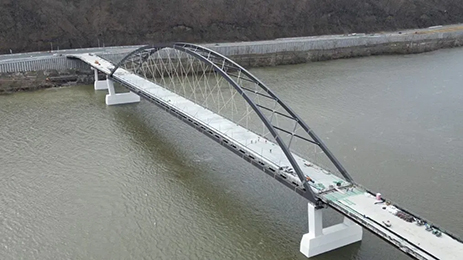
Four thousand tons of steel and concrete stretched over 1,893 feet will finally connect Wellsburg and Brilliant, OH, with grand opening of the Wellsburg Bridge Wednesday, Sept. 20.
Gov. Jim Justice will cut the ribbon on the long-planned bridge which will drastically reduce travel time between the two communities, spur economic development in the area, provide a new river crossing for commerce, and provide another way across the river if work needs to be done on neighboring spans.
After the ribbon-cutting ceremony, community members will host a festival on the bridge including a car show, food trucks, a disc jockey, and high school bands and choral groups. Additional details, including parking information and a schedule, will be announced closer to the date of the event.
Wellsburg Bridge is a significant project for Flatiron Corp. of Broomfield, CO, the main contractor of the $131 million project, was awarded the construction contract in 2016.
Separated by the Ohio River, residents in the towns of Brilliant and Wellsburg had to travel 8 miles north or 13 miles south to the nearest river-crossing points.
Because of traffic volume projections and the need for a safe and reliable span for commerce and emergency responders, the West Virginia Department of Transportation sought proposals to build a new bridge that would improve transportation infrastructure as well as enhance regional business growth.
Flatiron submitted qualifications in March 2016 and the DOT awarded Flatiron the contract later that year.
Flatiron also provided a unique alternative delivery method as construction began in April 2018.
Flatiron proposed building a tied-arch bridge main span that would be constructed offsite, upriver and delivered by barge to the project site for installation. Flatiron worked with project partners, including RS&H, TRC Engineers, and COWI North America on the project.
Project financing was made possible through a public-private partnership (PPP), involving Flatiron, West Virginia’s DOT, the Ohio Dept. of Transportation, as well as federal highway funds.
In an effort to reduce costs and shave a year off of the construction timeframe, Flatiron opted to build the tied-arch bridge off-site and deliver it by barge to the project site for installation in an effort to reduce costs and shave a year off the construction timeframe.
On April 26, 2021, the 830-foot main span was lifted onto two pairs of barges and moved into position in a massive, 13-and-a-half-hour operation. It was the largest bridge floating project ever attempted in North America.
The bridge was supported on the barges by eight sets of sectional pilings. Once in place, it was slowly jacked up and additional pylons set underneath until it was high enough to rest on its support piers.
“They alternated lifting it up, putting in more sections, and lowering it back down; kind of like Lincoln Logs,” said Tony Clark, District 6 engineer with the West Virginia Division of Highways.
West Virginia’s $2.8 billion Roads to Prosperity bridge and highway maintenance and construction program provided funds to complete the massive bridge project.
High school bands from both sides of the river have begun working together for a combined performance, and fire departments are planning a water brigade.
The total project involves the main span of 845 feet, and connecting spans of 618 feet on the Ohio side and 430 on the West Virginia side, for a total of 1,892 feet.
The determination of a need for a new Ohio River crossing between the Fort Steuben Bridge between Weirton and Steubenville and the Fort Henry Bridge between Wheeling and Bridgeport, was an outgrowth of the Brooke Hancock Jefferson Metropolitan Planning Commission 2020 Regional Transportation Plan that was adopted in January 1998.
It identified that a new crossing should be a top-priority transportation project.
PKG Consultants completed a Phase I Report in June 2000, which noted that both the Fort Steuben Bridge and Market Street Bridge were past their design life and had weight limits.
A Phase II Report, which explored alternatives for bridge crossings developed on preliminary engineering analysis, led to seven alternatives in September 2003.
A Phase III Report, which evaluated anticipated environmental impacts in accordance with the National Environmental Policy Act, was released in July 2012.
As the results of the studies, Alternative Crossing 8B was selected as the Preferred Alternative.
A Deck Width Study Report, produced by HDR Engineering in May 2014, looked into the relative cost of various deck width options, with deck widths ranging from 43-61 feet with varying configurations, with three main structure types: a simple span tied arch, a three-span continuous truss, and a three-span continuous cable-stayed.
It was decided to incorporate a shared-use path for pedestrians and cyclists as it would connect to the Brooke Pioneer Trail.
On April 26, 2021, the main span was lifted onto two pairs of barges and moved into position in a single 13½-hour operation. 5 The bridge was supported on the bridges by eight sets of sectional pilings. Once in place, the structure was jacked up, and additional pilings were set underneath until it was high enough to rest on its support piers.
With its estimated weight of 4,000 tons, the tied-arch span was the heaviest structure to be lifted in such a manner in the United States.
The dedication and opening of the bridge comes about a year after its original target completion date of the fall of 2022.